

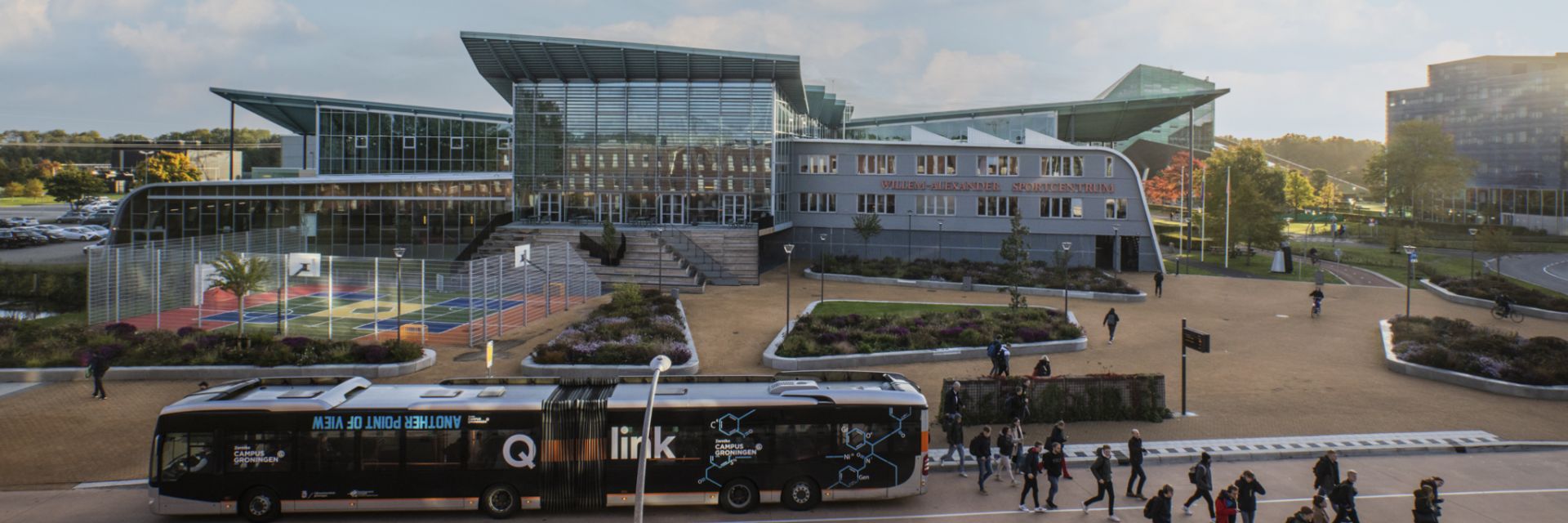
Working together to create an accessible and liveable Zernike Campus
At Campus Groningen, we are committed to ensuring that the Zernike Campus remains easily accessible and future-proof. Mobility plays a key role in this. Together with partners such as Groningen Bereikbaar, we are working on smart solutions that will keep the campus accessible to students, staff, entrepreneurs and visitors – now and in the future.
Read below the article that previously appeared in the Groninger Ondernemers Courant, in which Michael Myles, mobility programme manager at Zernike Campus, talks about the joint approach.
How will the rapidly expanding Zernike Campus remain accessible?
The Zernike Campus is one of the fastest growing campuses in the Netherlands. And that means there is work to be done in terms of the campus's accessibility. How will the Campus remain accessible and liveable in the future? Michael Myles, mobility programme manager at Zernike Campus, explains.
Work has been underway for some time to improve accessibility to the campus. This was necessary because during the large-scale projects Operation Julianaplein in 2022 and Operation Ring Zuid, every effort had to be made to keep the city accessible and minimise the number of cars on the road. These projects were used as an opportunity for the Campus to make significant progress in the area of sustainable mobility, also for the future. So even now that Operation Ring Zuid has been completed, accessibility remains an important theme.
The Zernike complex dates back to the 1960s, says Myles. Today, the campus is home to more than 250 companies and over 50,000 students. It is considered one of the most important campuses in the Netherlands. And in the meantime, the campus continues to grow. In terms of mobility, the campus has three key pillars: accessibility, sustainability and innovation, as laid down in the Smart Mobility Campus 2022-2030 action agenda.

Parking
One of the biggest challenges for the campus is parking. Parking pressure is already high, and this will only increase in the future if nothing changes. At present, a lot of space on the site is taken up by car parks. ‘In the future, we want to move cars to the edges of the campus, with smaller parking hubs,’ says Myles. These parking hubs must be easily accessible via the ring road. With such hubs, the “centre” of Zernike will remain car-free.
Car-calm
This also fits in with the broader ambition of a car-calm campus by 2030. ‘The campus is in transition. New functions are being added, such as student housing. So we need to look at creating a liveable campus,’ says Myles. ‘We don't want to become completely car-free,’ he explains. "So we will remain accessible to cars, but we would rather not have them driving around everywhere.
Mobility
But keeping the campus accessible requires more, including from companies and institutions. And their employees. ‘We are committed to sustainable mobility,’ says Myles. In short, that means fewer people travelling by car, more shared mobility, more people cycling, using public transport or working from home.
But how do you get employees on board? ‘Fortunately, we have gained a lot of experience in this area in recent years during the large-scale work on Operation Ring Zuid.’ At the time, Groningen Bereikbaar advised companies on how they could encourage their employees to travel less by car.
New parking policy at Hanze
This is also part of the campus strategy. In September, for example, Hanze University introduced a new parking policy: people who live closer than 15 kilometres away no longer automatically receive a parking space. Instead, there are arrangements such as public transport reimbursement and schemes to make cycling more attractive. The University of Groningen had already introduced a similar policy. ‘Exceptions have been considered,’ Myles assures us. ‘For example, if you live closer than 15 kilometres away, but public transport connections are poor, the stricter parking policy does not apply.’
De Hanze has also launched a pilot project with electric shared cars. Employees can use these shared cars for their business appointments. ‘The great thing about collaborating across the campus is that if something is successful at one company, we can quickly share it with the others. The initiatives come from the parties themselves, but we work together as much as possible.’
Fotography: Jan Buwalda
Source Article Groninger Ondernemers Courant